- Video
- Global Investment Research
- General Research Insights
New Zealand in 2026
- New Zealand’s growth upswing appears to have gained some traction heading into 2026.
- Growth is being supported by stimulatory monetary conditions and high commodity prices.
- With an election expected in late 2026, policymakers ought to focus on ‘pro-growth’ economic reform to lift productivity
Recovery after recession
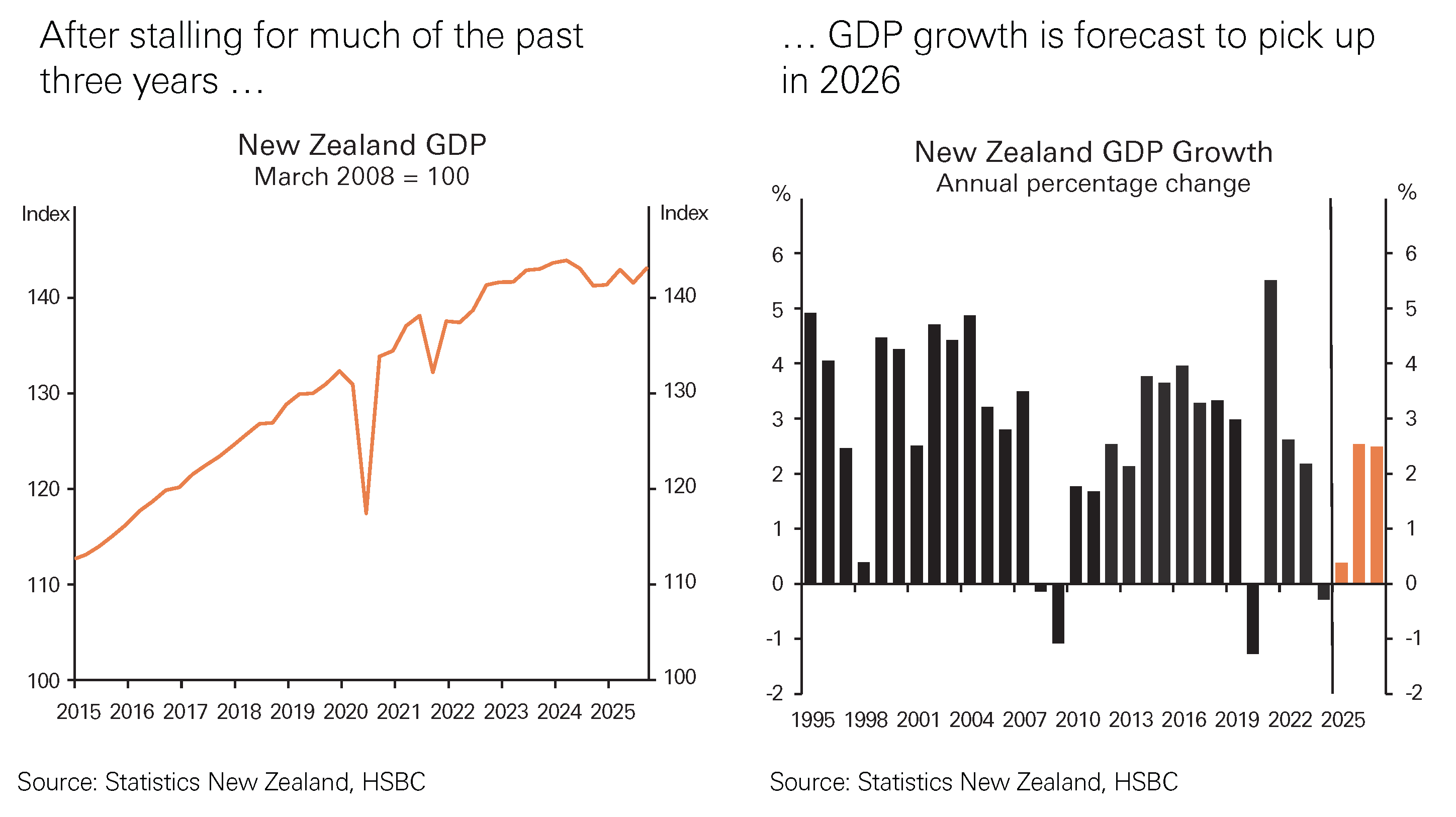
After three years of tough times, New Zealand’s economy finally appears to be in a solid growth upswing. Our central case is that GDP growth will pick up from a very weak 0.4% in 2025 to an above-trend rate of 2.5% in 2026.
In our view, the interest rate cycle has been a major driver of the economic cycle. As we see it, much of the weakness over the past few years had reflected the aggressive approach taken by the Reserve Bank of New Zealand (RBNZ) to managing the post-pandemic high inflation challenge. And now, following the RBNZ’s aggressive easing of policy, we see stimulatory monetary policy supporting the growth upswing. The cash rate has, after all, been cut by a hefty 325bp since August 2024 to 2.25%, which is well below neutral. We expect this to be a key support for a pick-up in activity in 2026, particularly household consumption and business investment.
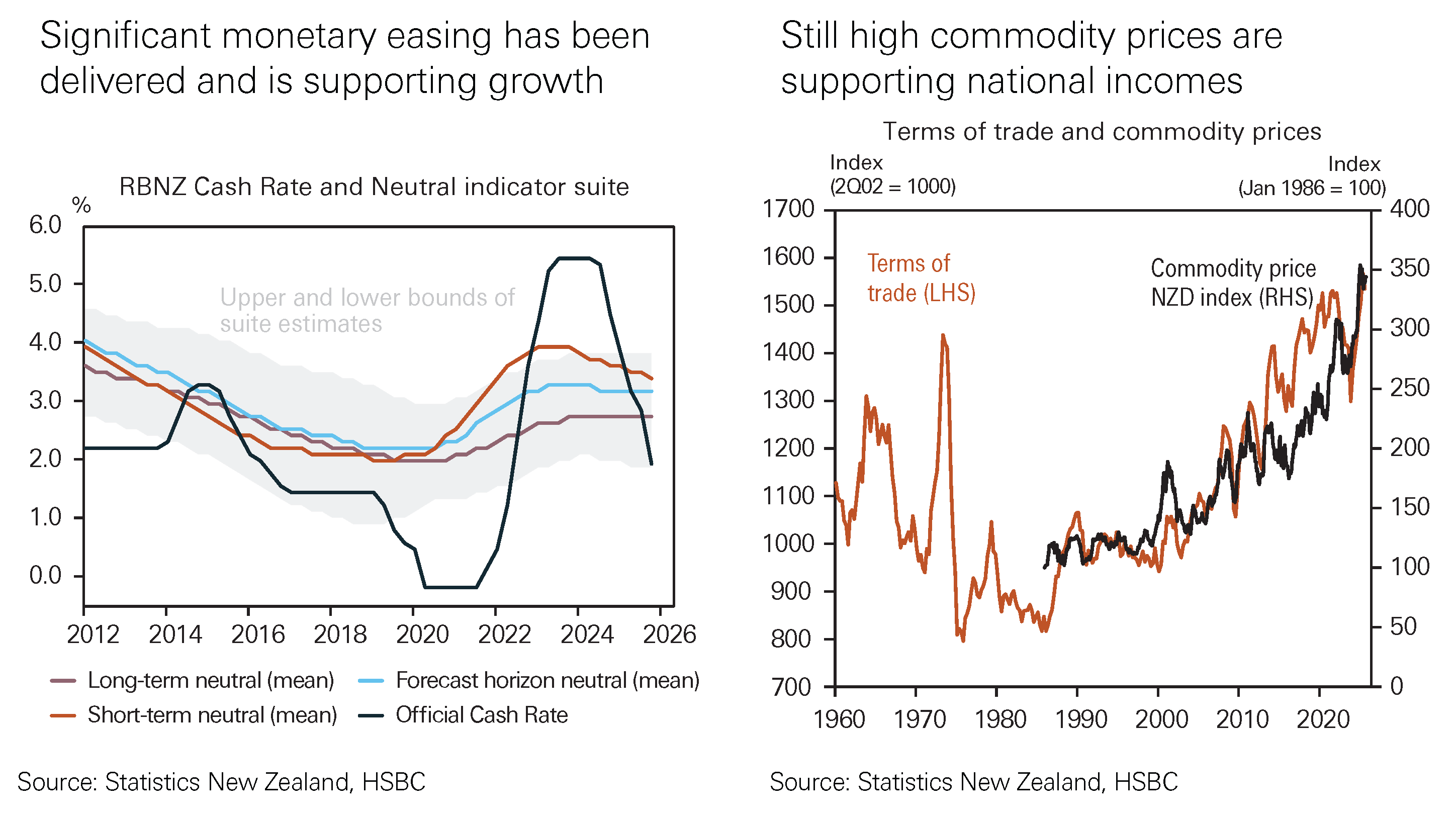
High commodity prices are also supporting New Zealand’s agricultural sector. So far, the boost to rural incomes has largely shown up in strong growth in the South Island, and much of the income boost seems to have been partly used to pay down rural debt, but we expect the upswing to spread more broadly into the economy in 2026.
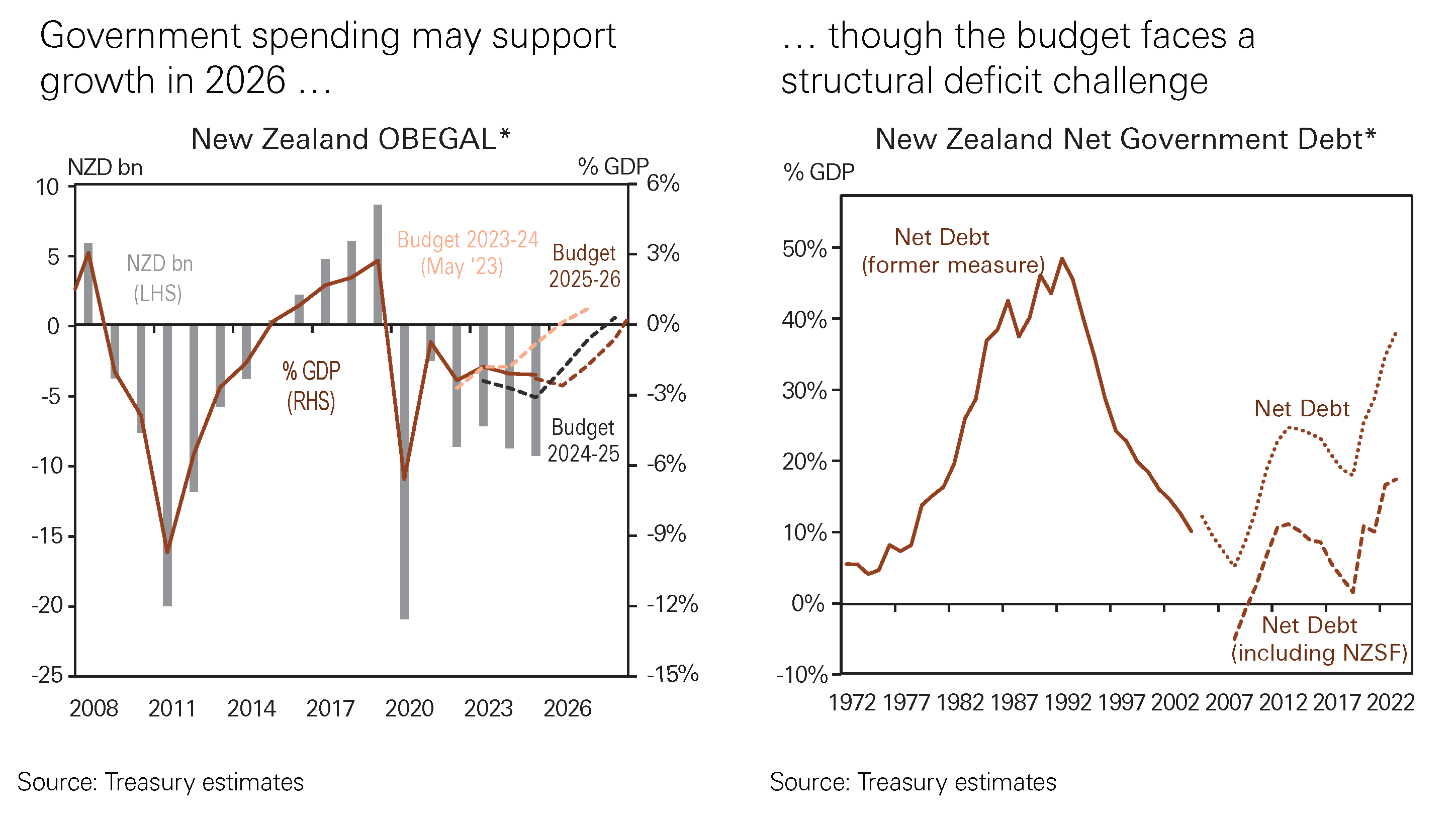
We also expect fiscal policy to support growth in 2026, as the government heads towards an election, which is likely in H2 2026. Although there has been a stated aim to deliver fiscal consolidation, electoral years typically see increased public spending.
Although the jobs market remains weak, employment typically lags the cycle, and we expect some improvement through 2026. As we see it, the RBNZ will only start to hike its cash rate once it is clear the unemployment rate has peaked, and when underlying inflation starts to lift. We expect hikes from Q3 2026.
Of course, the global backdrop continues to be an important driver of New Zealand’s growth. Fruit and meat exports are already around record highs, with long-term growth opportunities supported by China’s burgeoning middle-class consumers. The tourism sector is recovering as well. Finally, the tech sector is playing some role in the recovery, as AI, data centre investment, and tech exports gain momentum.
The following analyst(s), who is(are) primarily responsible for this document, certifies(y) that the opinion(s), views or forecasts expressed herein accurately reflect their personal view(s) and that no part of their compensation was, is or will be directly or indirectly related to the specific recommendation(s) or views contained in this research report: Jamie Culling and Paul Bloxham
This document has been issued by the Research Department of HSBC.
HSBC and its affiliates will from time to time sell to and buy from customers the securities/instruments, both equity and debt (including derivatives) of companies covered in HSBC Research on a principal or agency basis or act as a market maker or liquidity provider in the securities/instruments mentioned in this report.
Analysts, economists, and strategists are paid in part by reference to the profitability of HSBC which includes investment banking, sales & trading, and principal trading revenues.
Whether, or in what time frame, an update of this analysis will be published is not determined in advance.
For disclosures in respect of any company mentioned in this report, please see the most recently published report on that company available at www.hsbcnet.com/research.
Additional disclosures
- This report is dated as at 20 January 2026.
- All market data included in this report are dated as at close 19 January 2026, unless a different date and/or a specific time of day is indicated in the report.
- HSBC has procedures in place to identify and manage any potential conflicts of interest that arise in connection with its Research business. HSBC's analysts and its other staff who are involved in the preparation and dissemination of Research operate and have a management reporting line independent of HSBC's Investment Banking business. Information Barrier procedures are in place between the Investment Banking, Principal Trading, and Research businesses to ensure that any confidential and/or price sensitive information is handled in an appropriate manner.
- You are not permitted to use, for reference, any data in this document for the purpose of (i) determining the interest payable, or other sums due, under loan agreements or under other financial contracts or instruments, (ii) determining the price at which a financial instrument may be bought or sold or traded or redeemed, or the value of a financial instrument, and/or (iii) measuring the performance of a financial instrument or of an investment fund.
This document has been issued by HSBC Bank Australia Limited, which has based this document on information obtained from sources it believes to be reliable but which it has not independently verified. Neither HSBC Bank Australia Limited nor any member of its group companies (“HSBC”) make any guarantee, representation or warranty nor accept any responsibility or liability as to the accuracy or completeness of this document and is not responsible for errors of transmission of factual or analytical data, nor is HSBC liable for damages arising out of any person’s reliance on this information. The information and opinions contained within the report are based upon publicly available information at the time of publication, represent the present judgment of HSBC and are subject to change without notice.
This document is not and should not be construed as an offer to sell or solicitation of an offer to purchase or subscribe for any investment or other investment products mentioned in it and/or to participate in any trading strategy. It does not constitute a prospectus or other offering document. Information in this document is general and should not be construed as personal advice, given it has been prepared without taking account of the objectives, financial situation or needs of any particular investor. Accordingly, investors should, before acting on it, consider the appropriateness of the information, having regard to their objectives, financial situation and needs. If necessary, seek professional investment and tax advice.
The decision and responsibility on whether or not to purchase, subscribe or sell (as applicable) must be taken by the investor. In no event will any member of the HSBC group be liable to the recipient for any direct or indirect or any other damages of any kind arising from or in connection with reliance on any information and materials herein.
Past performance is not necessarily a guide to future performance. The value of any investment or income may go down as well as up and you may not get back the full amount invested. Where an investment is denominated in a currency other than the local currency of the recipient of the research report, changes in the exchange rates may have an adverse effect on the value, price or income of that investment. In case of investments for which there is no recognised market it may be difficult for investors to sell their investments or to obtain reliable information about its value or the extent of the risk to which it is exposed. Some of the statements contained in this document may be considered forward looking statements which provide current expectations or forecasts of future events. Such forward looking statements are not guarantees of future performance or events and involve risks and uncertainties. Actual results may differ materially from those described in such forward-looking statements as a result of various factors.
This document is for information purposes only and may not be redistributed or passed on, directly or indirectly, to any other person, in whole or in part, for any purpose. The distribution of this document in other jurisdictions may be restricted by law, and persons into whose possession this document comes should inform themselves about, and observe, any such restrictions. By accepting this report, you agree to be bound by the foregoing instructions. If this report is received by a customer of an affiliate of HSBC, its provision to the recipient is subject to the terms of business in place between the recipient and such affiliate. The document is intended to be distributed in its entirety. Unless governing law permits otherwise, you must contact a HSBC Group member in your home jurisdiction if you wish to use HSBC Group services in effecting a transaction in any investment mentioned in this document.
Certain investment products mentioned in this document may not be eligible for sale in some states or countries, and they may not be suitable for all types of investors. Investors should consult with their HSBC representative regarding the suitability of the investment products mentioned in this document.
HSBC and/or its officers, directors and employees may have positions in any securities in companies mentioned in this document. HSBC may act as market maker or may have assumed an underwriting commitment in the securities of companies discussed in this document (or in related investments), may sell or buy securities and may also perform or seek to perform investment banking or underwriting services for or relating to those companies and may also be represented on the supervisory board or any other committee of those companies.
From time to time research analysts conduct site visits of covered issuers. HSBC policies prohibit research analysts from accepting payment or reimbursement for travel expenses from the issuer for such visits.
In Australia, this publication has been distributed by The Hongkong and Shanghai Banking Corporation Limited (ABN 65 117 925 970, AFSL 301737) for the general information of its “wholesale” customers (as defined in the Corporations Act 2001). Where distributed to retail customers, this research is distributed by HSBC Bank Australia Limited (ABN 48 006 434 162 AFSL No. 232595).
© Copyright 2026, HSBC Bank Australia Limited, ALL RIGHTS RESERVED. No part of this publication may be reproduced, stored in a retrieval system, or transmitted, on any form or by any means, electronic, mechanical, photocopying, recording, or otherwise, without the prior written permission of the issuer of the report.